









The hidden bias in american youth soccer: why we're losing talent to birth month, and how bio-banding fixes It
The Hidden Bias in American Youth Soccer: Why We're Losing Talent to Birth Month, and How Bio-Banding Fixes It
Starting in August 2026, US Club Soccer, US Youth Soccer, MLS NEXT, and AYSO are shifting the age-group cut-off from January 1 back to August 1. The move will realign soccer with the school year, but it won't solve the deeper problem the entire youth game is living with: the Relative Age Effect. Whatever the cut-off date, players born in the first three months after it are systematically over-represented in academies, ODP selections, and Youth National Team pipelines — not because they're more talented, but because they're biologically older. In this guide, we break down the data, explain why bio-banding is the most effective countermeasure, and show how YouCoach AI gives every club a simple way to track biological maturation and make smarter development decisions.
The six chapters of this article
A systemic talent-selection bias isn't solved with a slide. We've structured this guide to give directors of coaching, academy staff, scouts, and parents a complete framework: we start with the data, explain the Relative Age Effect mechanism, show how leading federations are already responding, go deep on bio-banding, and close with the operational tools YouCoach AI provides for any club ready to do this in practice.
The research behind the bias
What USSF's own 2024 study on 3,364 youth female players reveals, plus the global evidence from U-17 World Cups and elite academies.
How the RAE actually works
Why eleven months of age is a chasm at 13, how the biological advantage self-reinforces into a competence gap, and the 25% of talent we're losing.
Why changing the cut-off isn't enough
Changing the cut-off from January to August won't eliminate the RAE. The problem is the one-size-fits-all age group model itself.
How the top academies respond
Futures teams, Avenir programs, Playing Down, and the Premier League Bio-Banding Programme: the global playbook for late developers.
Bio-banding, the science
What Premier League academy research shows about early and late maturers, scouting accuracy, and injury prevention during PHV.
How YouCoach AI makes it practical
Anthropometric tracking, natural-language analysis, and ready-made prompts to implement bio-banding in your club.
The Research Behind the Bias
The Relative Age Effect (RAE) is one of the most consistently replicated findings in sport science, and American soccer is no exception. In 2024, researchers working with the United States Soccer Federation published a study in Biology of Sport analyzing 3,364 youth female soccer players across all three stages of the USSF Youth National Team talent identification pipeline: Club, Talent Identification Center, and YNT. The result was unambiguous: players born in Q1 were significantly over-represented at both Club and TID Center levels, across virtually every age group from U13 to U18.
The findings hold globally. A Guardian analysis of the world's top 60 players born in 2001 found that 50% were born between January and March. A peer-reviewed review on RAE in soccer from 2010 to 2016 confirmed the pattern at every level of the elite game, in nearly every confederation. An earlier analysis of the US Olympic Development Program (ODP) found a strong RAE at state, regional, and national team selection tiers.
In plain terms: whatever the cut-off date — January 1 as it is today, August 1 as it will be starting in the 2026–27 season — players born in the first three months after the cut-off are dramatically over-represented in academy rosters, ODP selections, MLS NEXT programs, ECNL squads, and YNT pipelines. US Club Soccer itself acknowledges the phenomenon in its own communication about the cut-off change: "Relative Age Effect is the phenomenon of players born in the first three months after an age group cut-off to be over-represented in identification programs due to early maturation compared to their age-group peers."
The key insight — and this matters for the August 2026 transition — is that changing the cut-off date does not reduce the RAE. It simply shifts which months carry the advantage. The bias is structural to any one-size-fits-all age group system. Fixing it requires a different approach.
How the Relative Age Effect Actually Works
The mechanism is simple to explain, devastating in its consequences. Youth soccer, like most organized youth sport, groups kids by birth-year cohort. A child born in August 2012 and one born in July 2013 play together in the same age group (under the new August 1 cut-off). On paper, they're the same age. In reality — especially through puberty — they can differ by inches, pounds, speed, power, and coordination.
At 12, 13, 14 years old, eleven months of biological difference is a chasm. The older player is taller, stronger, faster, more coordinated. They score more. They win duels. They look more talented. Scouts notice them. They get selected for ODP, invited to TID Centers, placed on top academy teams. They play more high-level games, train with better coaches, get more development hours. The initial advantage — purely biological — compounds into a real competence gap.
Meanwhile, the child born later in the cohort, biologically almost a year younger, struggles to keep up. They don't get selected. They don't play. They get discouraged. Many quit. The ones who stay often do so in lower-quality environments that can't develop their actual potential.
"We are convinced we are losing 25% of the talent because of this problem."
— Bob Browaeys, former head of Belgian national youth teams
The number is what makes Browaeys's claim so sharp. It puts a figure on what is otherwise invisible. One in four potential talents is lost not because they weren't good enough, but because they were born in the wrong month. That's a staggering cost — human first, competitive second.
For U.S. Soccer, with its enormous youth participation base and growing investment in development pathways from MLS NEXT to GA to ECNL, the scale of the loss is massive. If even a fraction of that 25% could be recovered, the downstream impact on college recruiting, the professional game, and eventually the national team would be significant.
The American Paradox: The August Cut-Off Won't Fix This
The August 2026 transition is a good thing for many reasons: it reduces "trapped players," realigns soccer with the school-year, keeps kids with their classmates. US Club Soccer, US Youth Soccer, and AYSO are right to make the change. But it's worth saying plainly: it will not fix the Relative Age Effect. As US Club Soccer itself states: "No age group cut-off reduces concerns of relative age effect or changes the number of players impacted by relative age effect."
What will change is which kids benefit. Today, it's January and February babies. Starting in 2026–27, it'll be August and September babies. The bias simply relocates. Late maturers — the kids who happen to hit puberty later, who are still physically developing when the "obvious talents" are already dominating — will continue to be overlooked at the most critical selection moments of their careers.
This is a paradox worth sitting with. The kids we identify as "the best" at 13 are, in large part, the kids who happened to mature fastest. A few years later, when physical development evens out, many of them lose their edge — while the late developers who could have eventually been better are already out of the system. We don't see the loss, because by then those kids have stopped playing, or moved to recreational levels, and they're invisible to the talent pipeline.
There's a second paradox. American soccer is investing heavily in infrastructure, coaching education, and pro pathways. MLS NEXT has raised the floor of youth development. College soccer, the NCAA transfer portal, and NIL have opened new value for players. And yet, the selection filter at the top of the youth funnel is still heavily weighted toward biological precocity rather than actual talent. One of the most invested youth development systems in the world still relies on a selection filter that leans heavily toward biological precocity — and that's a gap worth closing.
The good news: the tools to address this exist, have been scientifically validated for almost a decade, and are now operationally accessible to any serious club.
How the Top Academies Respond
While the U.S. debates cut-off dates, leading European federations and academies have already moved past that conversation. They've recognized that no cut-off will solve the structural bias, and they've put in place parallel programs designed specifically to protect late maturers and give them a path to develop.
These four approaches share a philosophy: you can't evaluate a 13-year-old purely on what they show today, because what they show today is heavily conditioned by how far along their body's development already is. Whoever organizes youth soccer bears a responsibility to design pathways that account for this — otherwise the selection filter becomes a pure biological filter, and real talent is lost.
For U.S. Soccer and the leading American academies, the question is no longer whether to adopt something similar, but how — and at what scale.
Bio-Banding: What the Science Actually Says
Bio-banding is the most systematic of these approaches, and it deserves a deeper look because it's probably the single most effective tool a club or federation has to mitigate the RAE without overhauling its existing competition structure.
The concept, developed and popularized by Professor Sean Cumming at the University of Bath, is straightforward. In specific windows of the year, players are grouped not by date of birth but by percentage of predicted adult height. This value, calculable using the Khamis-Roche method from height, weight, and parental height, is a reliable indicator of the player's stage of biological maturation.
In practice: instead of grouping all U14s together, tournaments and training sessions are organized so that players at, say, 85–90% of their predicted adult height play together — regardless of chronological age. A precocious U13 and a late-developing U15 can end up on the same team because they're at the same stage of biological development.
What the Research Shows
The benefits of bio-banding are well-documented across a series of studies conducted on Premier League academy players (Southampton, Stoke, Reading, Norwich, AFC Bournemouth) and other elite environments. The findings converge on several concrete points.
For early maturers, bio-banding provides a more challenging context: they can no longer win duels on physicality alone, because their opponents are physically comparable. They're forced to develop technique, vision, and decision-making. Cumming's research shows that in bio-banded settings, these players make more short passes, dribble less, and report significantly higher perceived exertion (RPE).
For late developers, it's the opposite. They can finally express their qualities without being physically overwhelmed. They get more time on the ball, more decision-making opportunities, more space to show technical and tactical ability. Studies observe increased leadership, confidence, and in-game influence.
For scouts and coaches, bio-banding is a powerful diagnostic tool. A 2025 study published in the Journal of Sports Sciences showed that academy recruiters evaluated competitiveness, composure, decision-making, and "X-factor" more accurately when watching bio-banded matches, particularly for the biologically less advanced players. In other words: watching a player compete against biological peers lets you see their actual potential, stripped of the physical advantage or disadvantage.
There's also a significant injury-prevention benefit. During periods of rapid growth — the Peak Height Velocity (PHV) — the risk of muscle strains and joint overload increases sharply. Grouping players by maturation allows for more appropriate load modulation and matchup design compared to chronological age alone.
An Important Clarification
Bio-banding does not replace age-group competition. It's a complement, not a substitute. Cumming himself recommends limited application: typically 3–4 bio-banded tournaments per year, while the bulk of competition continues by chronological age. The reason is that age-group play has real value: it aligns players cognitively, emotionally, and socially, and teaches late developers the resilience of competing against bigger opponents (a psychological advantage many of them actually build from). Bio-banding fills in the gap, it doesn't replace the system.
The Six Operational Steps
To implement bio-banding in a club, here's what's needed:
- Systematically collect height and weight data from every player, on a regular schedule (at least every 3–4 months during the pubertal age bands).
- Collect parental height data, required for the Khamis-Roche calculation.
- Calculate each player's percentage of predicted adult height.
- Track this value over time and monitor its evolution, identifying the Peak Height Velocity as it happens.
- Use these values to compose bio-banded squads for dedicated training sessions or tournaments.
- Integrate the biological data into selection decisions, so you stop cutting players who are simply still developing physically.
Simple on paper. In the reality of a typical American youth club — where coaches are often volunteers or part-time, where registration data lives in one system, training attendance in another, and height/weight measurements (if taken at all) live in a spreadsheet on someone's laptop — it's prohibitively complex. The result is that bio-banding remains an idea discussed at coaching conferences but rarely implemented systematically. That's where YouCoach AI changes the equation.
How YouCoach AI Makes Bio-Banding Practical
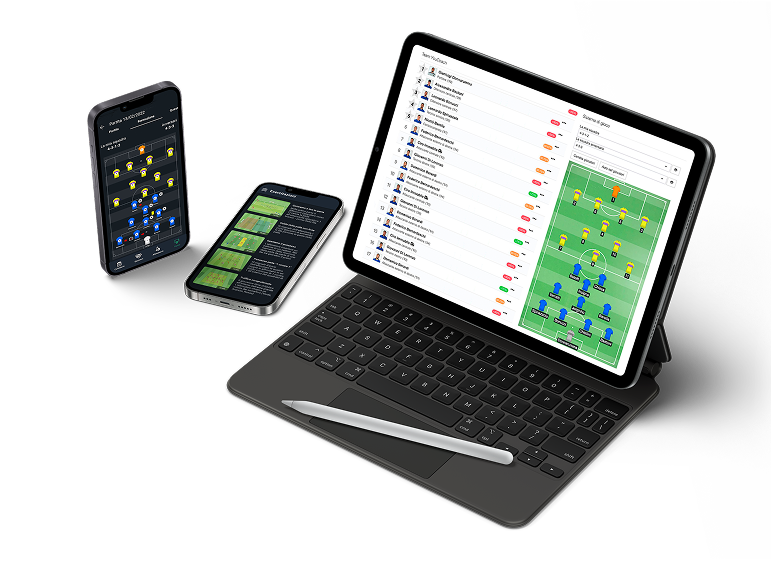
YouCoach is the platform over 100,000 coaches, clubs, and federations around the world use to manage training, exercises, loads, and player development. YouCoach AI is the intelligent assistant built into the platform. It knows your squad, your calendar, your players' data, and your methodology. It doesn't interpret or decide — it gives you the right information at the right moment, structured so you can act on it immediately.
For bio-banding, this means you can query your players' anthropometric data in natural language and get in seconds the analysis that would otherwise take a sports scientist hours. The AI cross-references growth data with Training Load (sRPE, Hooper Index) and injury reports, returning operational guidance: who's in accelerated growth, who needs load modulation, who to watch closely.
Segmentation by Maturation Stage
The most direct bio-banding function is YouCoach AI's ability to read your squad's anthropometric data and suggest homogeneous groupings by biological stage. In seconds you get a clear picture of who's pre-PHV, who's in the middle of it, who's already past it, with practical recommendations for how to group them for specific sessions.
Load Modulation and Injury Prevention
Periods of rapid growth bring an elevated risk of muscle-tendon and joint overuse injuries. With Training Load Monitoring active, YouCoach AI reads the week's sRPE and Hooper Index data and cross-references them with anthropometric measurements to flag players going through a biologically sensitive moment who need reduced loads.
Individual Development Plans for Late and Early Developers
A serious approach to bio-banding means differentiating development paths. A late developer needs a different focus from an early developer: the former should work on technical and coordination skills while protecting load in anticipation of growth; the latter needs cognitive and decision-making stimulus to avoid settling into the physical advantage. YouCoach AI generates structured individual development plans that take this explicitly into account.
Bio-Banded Sessions and Modulated Drills
Once groups are identified, you need to build sessions that match. YouCoach AI generates complete training sessions in 10 seconds, calibrated to the biological profile of the group, drawing from the platform's library of 2,000+ exercises. The AI knows that the same drill needs different parameters (volume, density, small-sided game pitch dimensions) depending on the stage of growth.
The Context the AI Uses
When you ask YouCoach AI about bio-banding, the assistant isn't reasoning in a vacuum. It takes into account the age group of the team, available anthropometric data, each player's health status, the latest TLM readings if the module is active, and the history of sessions already completed in the season. Every response is specific to your squad and your current situation, not a generic template.
To go deeper, visit the YouCoach AI page, read "YouCoach AI: The Assistant That Supports Your Methodology", and explore "Introduction to Bio-Banding and Its Scientific Basis". YouCoach AI is included in every subscription plan with dedicated AI credits.
Ready to use YouCoach AI in your club?
Anthropometric data, maturation stage, training load, and 2,000+ exercises in a single platform. Query your data in plain English and make better development decisions for your players.
Are We Picking the Best, or Just the Most Ready?
The August 2026 cut-off transition is an opportunity. Not because it fixes the Relative Age Effect — it doesn't — but because it forces the entire American youth soccer ecosystem to reconsider how selection, development, and age grouping actually work. If the only thing that changes is the calendar, we'll have missed the moment.
Federations with less history and less investment than U.S. Soccer have recognized this as a solvable problem and have organized around it. Belgium, France, Germany, and England all built parallel pathways for late developers. The U.S., with its scale, its resources, and its growing development pipeline, has no excuse not to do the same.
The real question — one every DOC, academy director, and club decision-maker should be asking — is simple: are we picking the best players, or just the most physically ready ones?
For clubs that take that question seriously, bio-banding isn't an academic exercise. It's a concrete, economically accessible, scientifically validated tool. And with YouCoach AI, it's now operationally simple to integrate into the daily workflow. The 25% of talent Bob Browaeys says we're losing — it gets recovered one player at a time, one data point at a time, one informed decision at a time.
Sources
- Finnegan L., van Rijbroek M., Oliva-Lozano J.M., Cost R., Andrew M. (2024), "Relative age effect across the talent identification process of youth female soccer players in the United States," Biology of Sport.
- US Club Soccer, "Age Group Cut-Off Update for 2026–27 Season," June 2025.
- US Youth Soccer Federation, "Updated Decision on Age Group Formation," 2025.
- Cumming S.P. et al., bio-banding research programs at Premier League academies, University of Bath.
- Premier League, Elite Player Performance Plan (EPPP) and Bio-Banding Programme.
- "Soccer and Relative Age Effect: A Walk among Elite Players and Young Players," peer-reviewed review (PMC).
- The Guardian, analysis of top 60 world soccer players born in 2001.