






Defensive tactics principles
- Markers
- Balls
- Vests
- Playing Area: 20x30 meters / 22x33 yds
- Players: at least 6 (3 attackers, 3 defenders); Ideally, form 3-4 groups of 3 people each, who take turns working so that they can have optimal recovery times
- Duration: 20-25 minutes, including breaks for explanations and corrections
| Summary | Secondary Objectives |
|---|---|
|
Individual and collective defensive tactics, ball attack, defensive diagonals, positioning, and man-marking |
Dribbling, Feints and tricks, Losing your marker, Pass, Individual defensive tactical principles, Positioning, Intercepting, Tackling, Man on man, 1 versus 1, 2 versus 2, Cover, Marking up in anticipation |

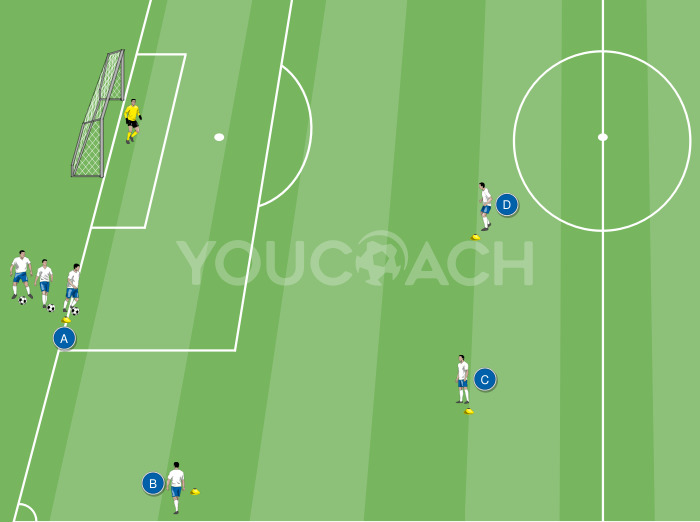
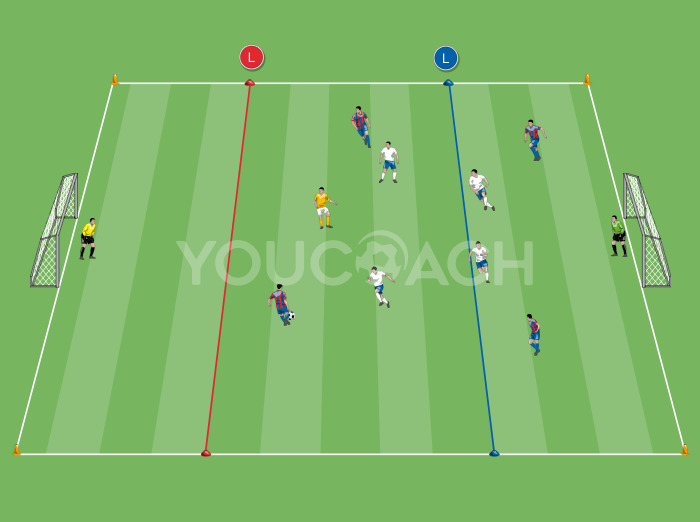
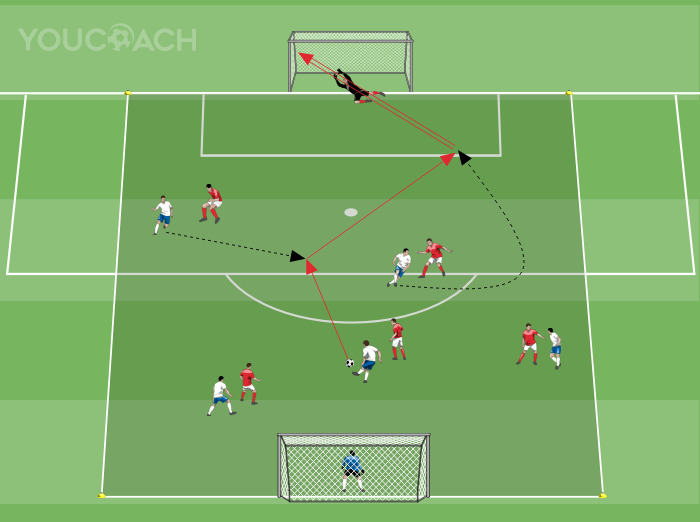
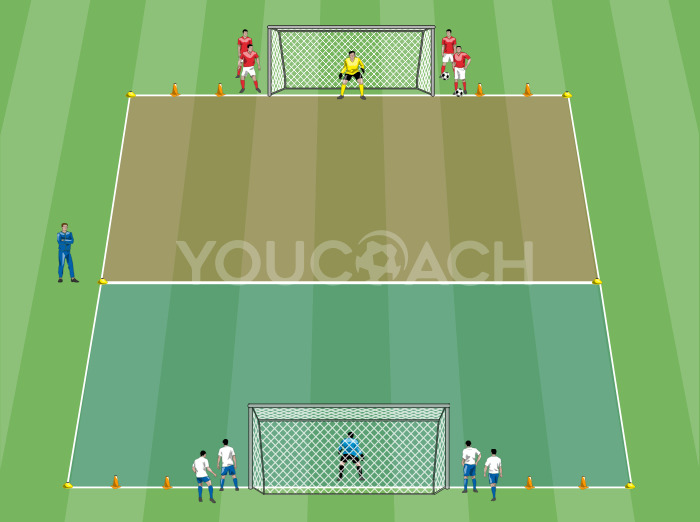
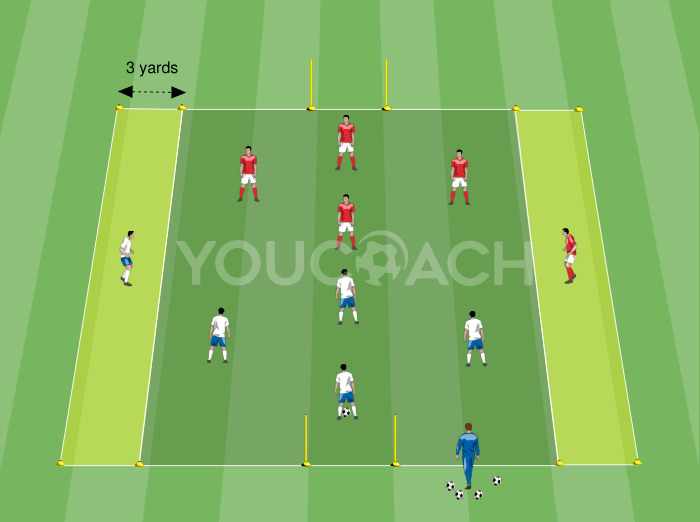
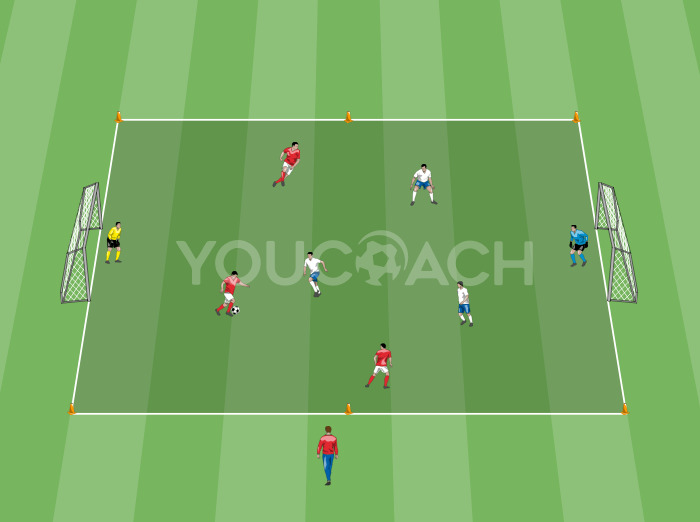
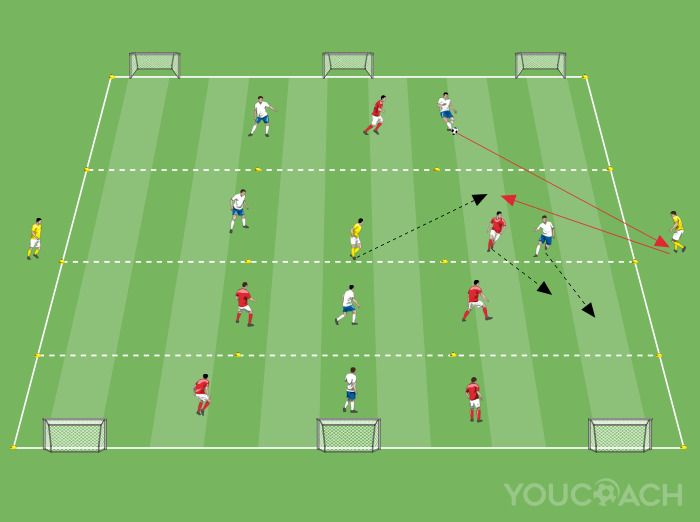
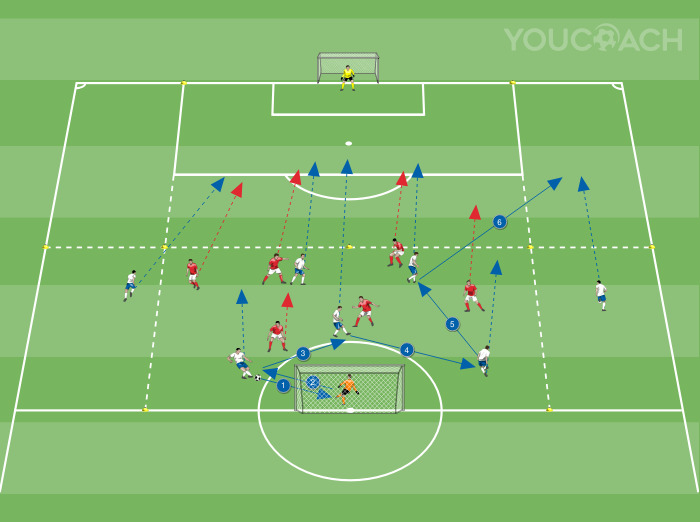
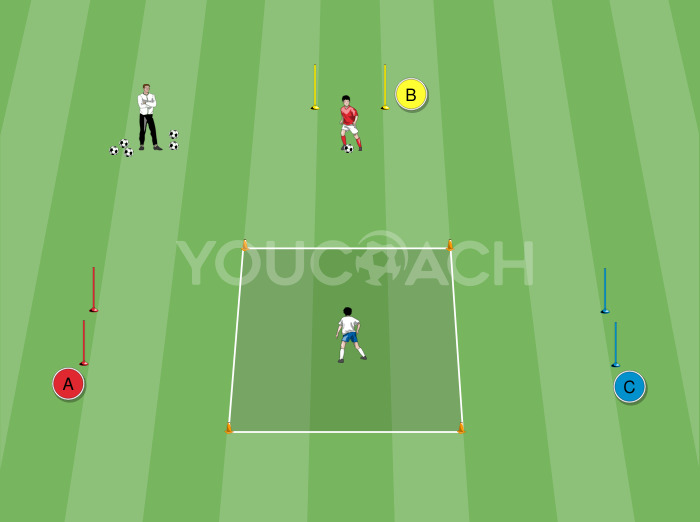
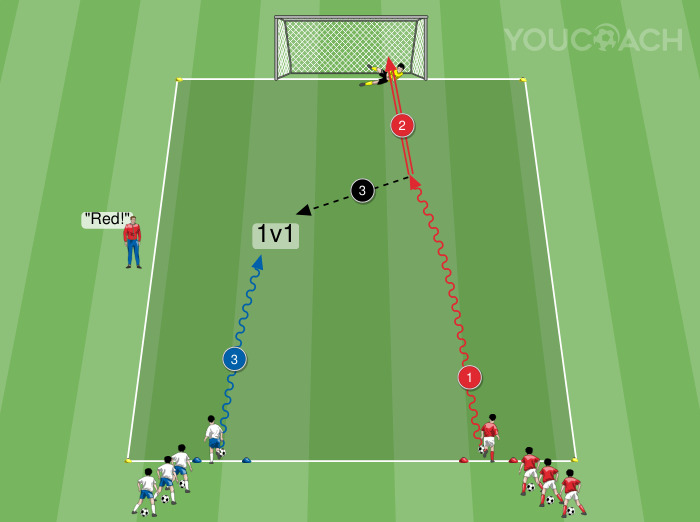
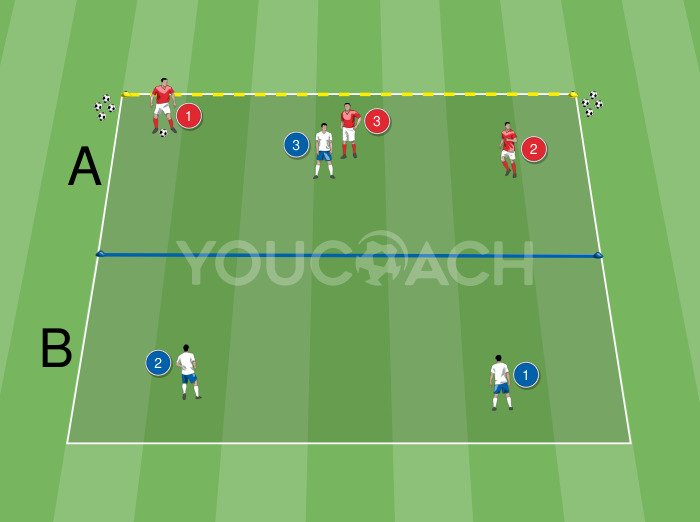
Use the markers to create a playing area measuring 30x20 meters/33x22 yards, divided by a line running across approximately halfway through the rectangle (this creates two halves of the field measuring 20x15 meters/22x16 yards: ZONE A at the bottom, where the 3 defenders and one attacker are initially positioned, and ZONE B at the top, where the other 2 attackers are initially positioned). Three defenders (red in the picture) are positioned in the playing area with the aim of defending the end zone (yellow dotted line in ZONE A) and three attackers (white in the picture) with the aim of crossing the yellow dotted line with the ball. The dividing line between the two zones (blue) limits the movement of the attacker who is closely marked by defender 3 (see picture); the position of the line affects the set objective: the closer it is to the goal line (smaller ZONE A), the more the movement of attacker 3 is limited (thus facilitating marking), at the expense of greater coverage of space in the initial 2v2 in ZONE B. On the other hand, if the blue line is farther from the goal line (larger ZONE A), it makes it easier for defenders 1 and 2 to pressure the attackers in ZONE B, but it gives attacker 3 more freedom of space in ZONE A. Keep balls at the sides of the playing area to give continuity to the exercise.
- The drill starts with red defender 1 kicking the ball from the goal line to one of the two attackers in the depth of ZONE B (white player 1)
- While the ball is in motion, red defender 2 quickly closes in on the attacker receiving the ball as he controls it (pressing movement on the ball carrier)
- After playing the ball, red defender 1 immediately gets up to cover the teammate who has moved onto the ball carrier, effectively creating a 2v2 situation in the half of the field opposite to the end zone line (ZONE B) where the red defenders will work on covering to take away space from their opponents (ball attack movements and diagonal coverage)
- Beyond the blue line, in ZONE A, a 1v1 is played simultaneously with defender 3 red marking attacker 3 white. The attacker tries to lose the marker to receive a through ball from the teammates and cross the end line with the ball or, at the very least, to support a teammate who, by running into space, tries to cross the line to score a point

- The attacking team scores a point by carrying the ball over the end line, while the defending team scores a point by recovering the ball and carrying it over the opposite line in ZONE B (again, while carrying the ball)
- Attacker 3 is restricted to unmarking movements only within ZONE A (see pic), in order to “facilitate” the work of the defenders
- For attackers, it is possible to shoot at goal after crossing the end line, so place a standard goal with a goalkeeper in defense at the desired distance. In a second step, you can remove the central dividing line (thus creating a single, larger playing area). This will complicate the task both for those directly marking the white attacker 3 (who will have more space) and for those working in a 2v2 high pressing, where position changes could alter the reference points
- Work in the non-possession phase on three elements: pressing the ball carrier, coverage (defensive diagonal), and tight marking:
- The coach must assess the distance that the defender maintains from the attacker, knowing how to read the game correctly and interpret it in the best possible way and, above all, pay attention to the attack on the ball and the posture with which the opponent is faced, trying to exclude a line of play by directing it to the “closed" side of the field
- With regard to the coverage provided by the second defender, it is essential that he works to close down the deep passing lanes and is ready to intervene and apply pressure if the ball is passed sideways to the other attacker (player 2 in white in the picture). He may also have to intervene directly on the ball carrier if the latter has managed to dribble past the direct opponent. The defender who goes to cover must be quick to close down and help the teammate so as not to leave him outnumbered
- In 1 v 1 marking, the coach must encourage both anticipation and depth coverage, focusing heavily on tight marking without the defender ever losing sight of the ball and the attacker