









Conditioned match: headers
Conditioned game that trains headers alternated with coordination courses
- 4 cones
- 2 goals
- 4 poles
- 4 low hurdles
- 5 vests
- 8 markers (4 per color)
- Balls
- Playing Area: 20x25 meters / 22x27 yds
- Players: 10
- Duration: 16 minutes
- Series: 4 of 3 minutes each with 1 minute of recovery between sets
Conditioned game that trains headers alternated with coordination courses
Secondary Objectives
Pairing, Eye-breech coordination, Balance, Vestibular information, Quickness, Aerial contrast, Aerial Challenge, Header with the feet on the ground, Header from a standing jump, Header in elevation, Diving header, Finishing, Marking up in anticipation, Read the intentionsOrganization
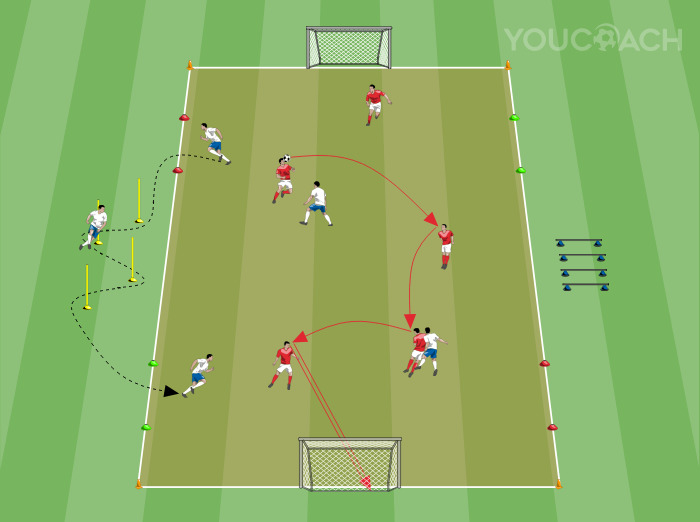
This drill can be played with anywhere from six to ten players, to create 3 v 3, 4 v 4, or 5 v 5 situations. Use four cones placed along the sidelines to mark out a 25x20-meter/27x22-yard field (adjust the dimensions based on the number of players). Place a mini goal at the center of both short sides. Place the balls near the two mini goals. Outside one long side, create a zigzag course with four poles (left side in the picture) while outside the other long side, position four low hurdles about half meter apart (right side in the picture). Along both long sides of the playing area, use markers to create two small gates marking the entrance and exit from the playing field for the coordination course (green and red gates in the figure).
Description
- A 5 v 5 game is played involving passes and goals scored in the mini goal using only headers (the sequence of headers is initiated by the first player using their hands)
- At the end of each play, that is, when a team loses possession (e.g., the ball goes out of play) or scores a goal (scoring in the opponent’s mini goal):
- The white team sprints toward the zigzag course formed by the poles (players take turns running through it after passing the ball to a teammate)
- The red team sprints toward the low hurdles and overcomes them at speed (players take turns running this course after passing the ball to a teammate)
- Both teams exit the playing area through the red gates and re-enter the field through the green ones
- Once back from their respective courses, the players become defenders and try to stop the opposing team’s play or launch their own counterattack
- At the end of each round, switch the courses for the two teams (the white team plays the obstacle course, and the red team plays the zigzag course between the poles)
- The team that scores more goals wins
- Allow adequate recovery time after a series of plays
Rules
- Players may only head the ball (except for the first pass in the sequence, which must be made with the hands)
- If the ball hits the ground, possession goes to the opposing team
Variations
- The goal is valid when all team members have touched the ball with their heads
- Execute passes and shots on goal using volleyed passes instead of two-touch or one-touch headers
Coaching Points
- Header:
- When heading the ball from a stationary position, the feet should be slightly apart to maintain balance and allow greater freedom of movement for the torso, which is essential for generating power before striking the ball
- When heading the ball in the air, the timing of the jump is crucial; striking the ball at the apex of the jump allows for greater power and accuracy due to the ability to execute the technical movement more effectively
- Remind players to correctly assess the ball’s trajectory for better timing of the header
- To direct the ball to one side, the player must bring the corresponding leg behind the torso (right direction—right leg moved slightly back, and vice versa)
- The arms should move forward and upward to aid in elevation, balance, and power generation, then swing outward for protection
- During a frontal header, the neck muscles must be contracted to facilitate the backward-to-forward movement, and the eyes must remain open to track the ball
- During a side header, the neck muscles are contracted to facilitate rotation; the body moves from the starting position to a closed position with rotation in the desired direction
- Try to alternate the loading and pushing legs during the takeoff