













U15-U14 Complete Season Plan - User guide
Start planning your season in just a few clicks! Here's how to get the most out of your YouCoach Complete Season Plan.
Introduction
A Season Plan for a specific category: discover the annual training program created by the YouCoach staff
YouCoach introduces the "Complete Season Plans," a specific and versatile annual training program for different categories, designed to guide coaches through a carefully planned path, session after session, covering the full 360° development of players' technical, tactical, physical, coordination, and social-emotional skills.
Within each program, coaches will find up to 500 drills for their category: a wide pool of options that, spanning different training methods, keeps scheduled sessions consistently varied and engaging, aiming for continuous player involvement.
The main goal is to offer staff a complete yet flexible and adaptable tool, helping coaches establish a shared methodological approach to maintain throughout the year, one that every coach can adapt to their own philosophy, habits, skills, and ideas.
At the foundation of this technical project are precise methodological principles and choices that guided the YouCoach staff in designing this complex program, then adapted into different goals and content based on the needs of different age groups.
Download the PDF manual with instructions
Methodology
The methodological core shared across all age groups is building a team with the will to dominate play through possession of the ball; applied to the specific needs of each category, this translates into greater attention to individual technical and tactical aspects in the grassroots stages (passing intensity, oriented control, combining technical skills), moving toward greater focus on collaborative play (2-3 player combinations), up to a higher volume of work on collective play for the older categories (among others, build-up play, ball circulation, possession management). In fact, the possession phase is always present in every training session and notably stands out in the total annual minutes dedicated to it compared to the minutes dedicated to the non-possession phase. The underlying principle of building a positive, proactive team is further expressed through other sub-principles, such as building from the back to manage and control play, or the ability to play between the lines of pressure. Alongside these methodological pillars are:
- the importance placed on verticality of play and gaining depth, applied in practice through the choice of tools such as conditioned games and positional games (used to develop the ability to gain depth through effective use of space);
- the intensity of work, always prioritized over volume of work: for this very reason, the time dedicated to each training phase never exceeds 15-20 minutes, reflecting greater attention to quality of work rather than execution time.
Another notable methodological choice concerns the random scheduling of training tools used throughout the season to put the proposed principles of play into practice. The program is not driven by technical or tactical objectives as such, but rather by specific principles for each category and the amount of work needed to develop those principles; the choice of tools and individual drills came only afterward, randomly distributing the tools to be used over the course of the season. The methodological choice to train the same principle using multiple different tools is therefore entirely intentional and a cornerstone of the annual programs for all categories.
Regarding the performance area, the key points of the chosen methodology can be summarized as gradual load progression considering the different moments of the season (pre-season preparation, in-season, winter break, in-season), overall approach (which favors, especially in youth development, ball-based work over work without the ball), adapting content to the specific needs of each age group, and a game-oriented approach over work without the ball through the most varied and engaging proposals possible.
In every season, the YouCoach staff has also paid particular attention to individual injury prevention, reflected not only in the selection of drills but especially in the methodological choice to dedicate two specific phases of each training session to this aspect (resulting in a significant number of annual minutes dedicated to players' movement, coordination, and physical-athletic development).
Below we summarize the key principles of play underlying the annual programs.
Program Structure
Complete, category-specific, customizable: here's how YouCoach's new Season Plans are organized
Each Season Plan is a collection of hundreds of training sessions and drills, carefully selected to follow a path covering the entire sports season.
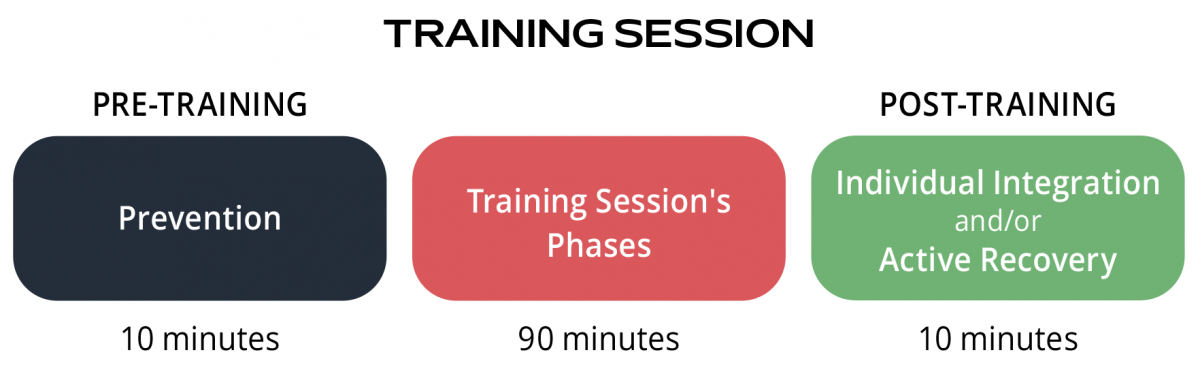
In the competitive sector, the Prevention phase includes dry-land activities for the whole team, present every week, covering neuromuscular work, joint mobility, and core stability.
The central phases were chosen to put the previously mentioned principles into daily training practice: they are summarized below for grassroots activity and competitive activity respectively. From session to session, they are used in whole or in part, and vary throughout the season depending on the day of the week, the specific session, and the period.
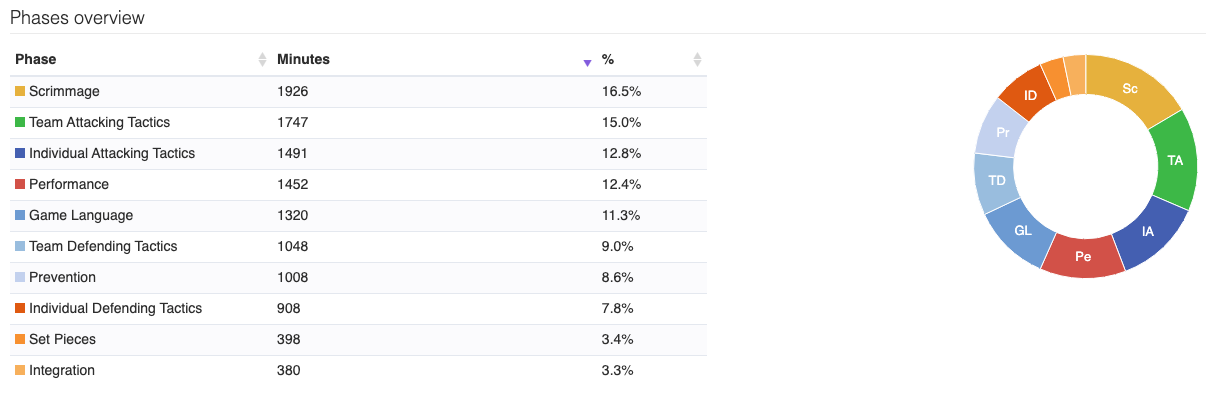
Training Session's Phases of the Season:
- Game Language
- Prevention
- Performance
- Individual Attacking Tactics
- Team Attacking Tactics
- Individual Defensive Tactics
- Team Defensive Tactics
- Scrimmage
- Set Pieces
- Integration

The game language phase focuses on technical/tactical/cognitive activation, primarily with the ball, expressing the importance of building the foundations needed to master ball possession with the right technical and coordination skills. Not surprisingly, this phase uses a wider variety of tools in grassroots activity compared to adult categories, reflecting the greater need to multiply stimuli and broaden children's technical and motor experiences compared to adults.
Among the listed phases, individual and team offensive tactics are always present, while the non-possession phase and set pieces alternate week by week. Set pieces in particular deserve a special mention, since methodologically it was decided to include them across all categories, though with different applications and goals: in grassroots activity they were mainly used as challenges with a playful or individual technical focus (shooting challenges, throw-in drills, penalty kick challenges), while in competitive activity they were approached in terms of specific tactics.
The collective and unit tactical principles proposed starting from the U13 age group are based on the 4-3-3 system: this is not a random choice, but is justified by the fact that, given the principles outlined above, this system appears to be the most compatible, versatile, and adaptable. Each coach is therefore free to choose, modify, and adapt drills according to their preferred system of play.
As for the game phase, in all age groups both thematic/conditioned games and free play alternate over the course of the week; however, in grassroots activity, the minutes dedicated to free play are nearly double those dedicated to conditioned games, while this ratio is reversed in the competitive categories.
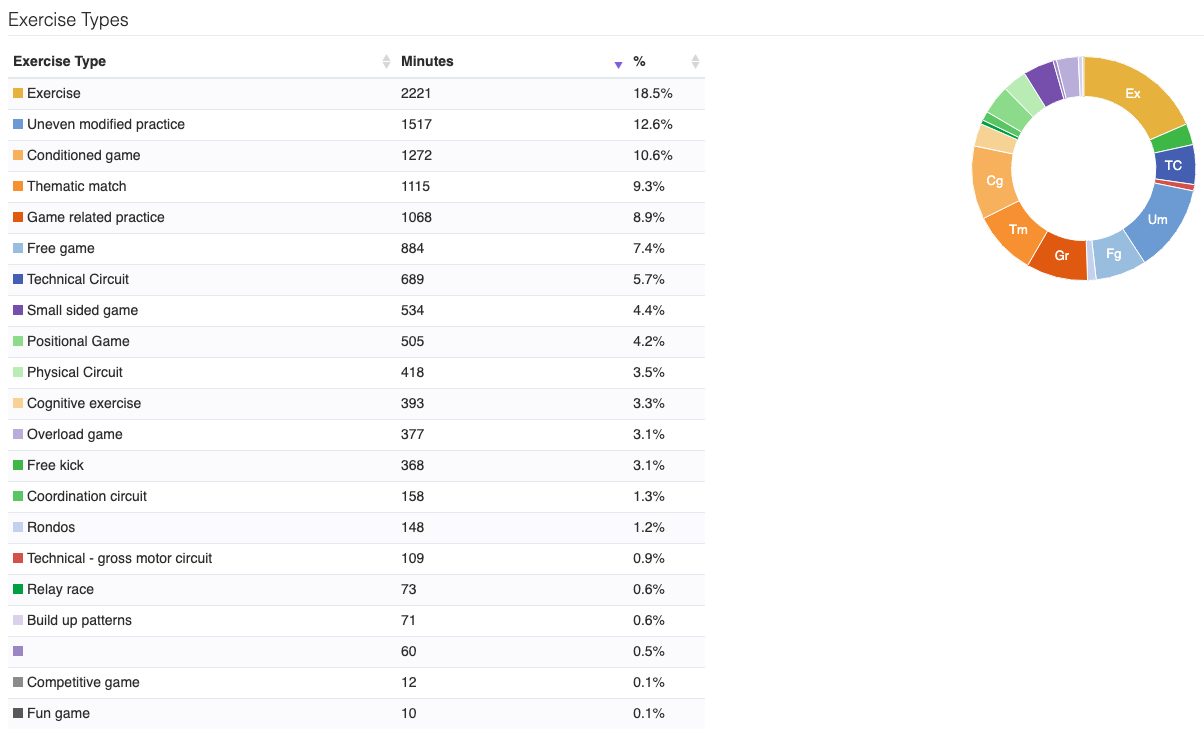
The drills chosen for each session are designed for good numerical adaptability based on squad size, allowing collective work to be paired with simultaneous small-group drills.
In the competitive categories, the scheduling of the performance phase follows the classic annual structure: the preparation phase, which prioritizes conditioning components like strength and endurance, is followed by the block dedicated to the in-season period, athletic reconditioning during the winter break, then a second in-season block. Regarding the weekly training cycle, the schedule dedicates Tuesday sessions to aerobic work, Wednesday sessions to strength work, and Friday sessions to speed/agility. In the youth sector categories, ball-based work is favored over dry-land work to develop conditioning aspects.
With the goal of prioritizing intensity of work over volume, the time allotted for individual work was set at a maximum of 10-12 minutes, while collective work is capped at 10-15 minutes.
From the U13 category through the First Team, the post-training activity is called Cool Down: in the final 10 minutes, players can do dry-land activities, active recovery exercises, or specific physical work, either individually or in small groups, once a week at the end of the first or second session (this phase is intensified only during the summer preparation period).
Season Plan for U15-14
After an initial phase featuring a higher number of weekly training sessions and friendly matches, the season typically includes three sessions of approximately 90 minutes each per week, plus, in some cases, a supplementary physical and/or technical training session that may take the form of individualized work for one or more athletes, depending on their specific weaknesses and needs. The online program includes examples of some suggestions that can be applied at this time, but each coach can modify them as desired, adding or removing content from the original plan.
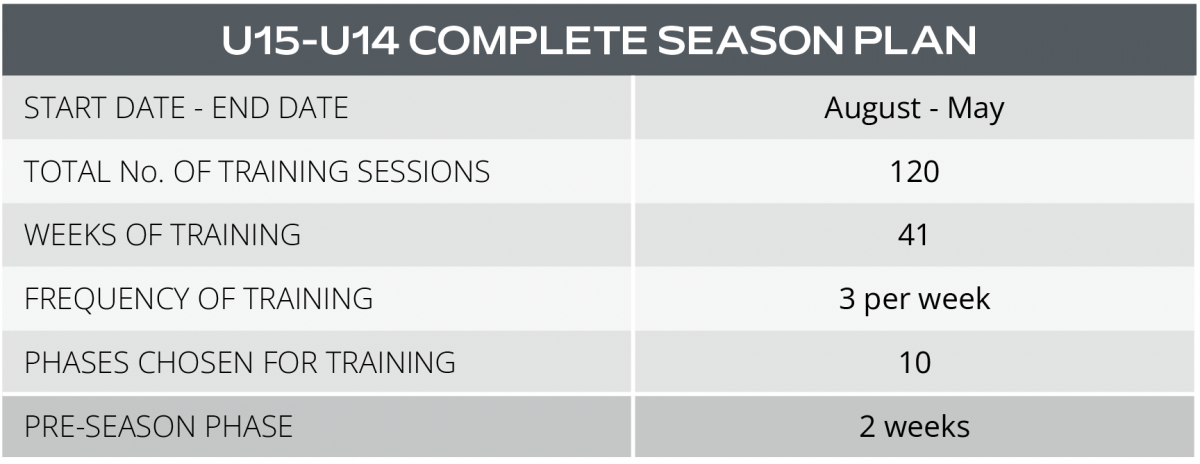
The annual program includes 41 weeks of training with three sessions per week plus a match, including preseason training and a training camp during the winter break, for a total of 120 training sessions and over 500 different drills.
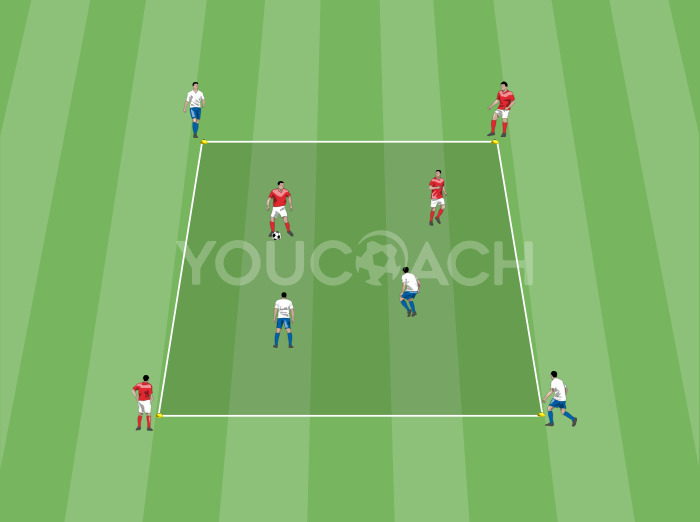
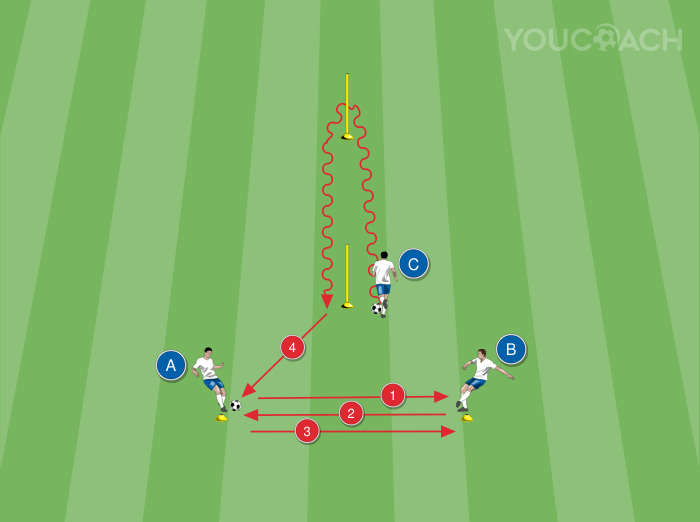
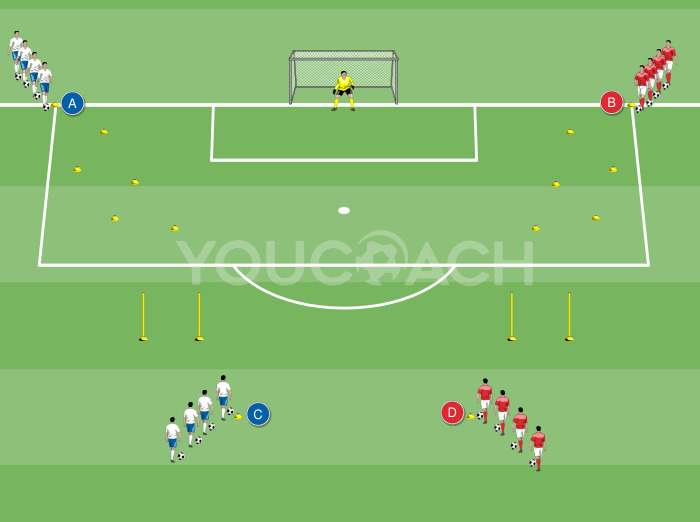
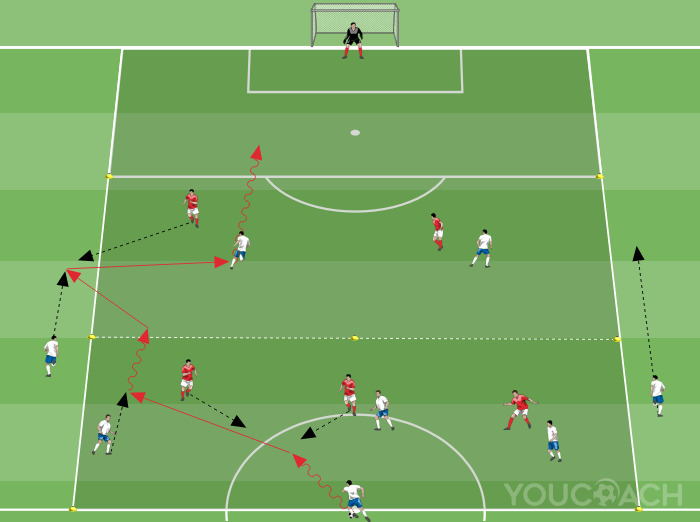
The key elements of the game that form the backbone of the training program for the Giovanissimi age group (developed in a non-standardized way throughout the entire season and using various training methods) include core stability, proprioception, and coordination exercises (for the prevention phase); technical, tactical, and cognitive activation (for the game language phase); ball possession drills, rondos and small-sided games, creation and use of half-spaces, finishing, and positive transitions (for the individual offensive tactics phase): building from the back with constant involvement of the goalkeeper, one-on-one situations, offensive buildup, conditioned matches, and positional drills (for the team offensive tactics phase), individual and small-group defensive tactics always in game situations, defensive transitions (for the individual defensive tactics phase), collective defensive tactics and zone-based defensive tactics in game situations, gegenpressing (for the team defensive tactics phase), coordination skills, aerobic capacity, anaerobic capacity, aerobic power, speed, quickness, strength, and agility (for the performance phase), set pieces, indirect free kicks, corner kicks, direct free kicks (including free kicks and penalty kicks) kickoffs, and throw-ins (for the set-piece phase), thematic/conditioned matches and free-play matches (for the match phase), and individual or group drills without the ball (for the integration phase).
The training blocks are organized into a total of 10 phases that can be used as desired during individual sessions; these are divided into physical (covering both performance and injury prevention), technical, and tactical blocks.
The training format for all three weekly sessions includes:
- Activation phase (technical, tactical, cognitive)
- The main part of the workout, which is divided into two major phases:
- Offensive phase, or phase of game dominance, with the primary objective being the ability to interpret space and gain depth (individual playing principles + collective playing principles)
- Defensive phase, with the primary objective being the ability to organize individual and collective opposition in defense of the goal, allowing for the rapid recovery of possession (individual defensive skills and collective defensive skills)
- Free-play Match / Thematic Match / Conditioned Game
- Set pieces (developing set pieces in favor of and against the team).
The main part of the training session varies depending on the day of the week.
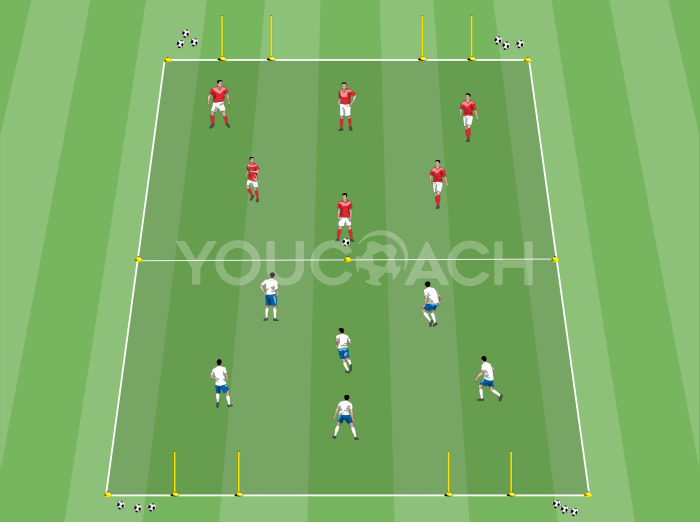
- The introductory session: The focus is on developing collective offensive and defensive tactics, preferably in open spaces, through ball possession drills, offensive buildup, positional play, and large-group drills (with a high number of players).
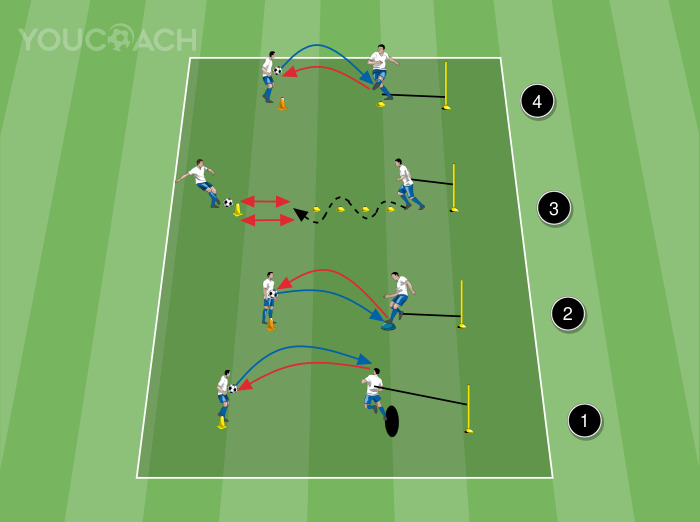
- The main session: The focus shifts to more individual or small-group tactical work, aiming to maintain high intensity throughout the various phases of the session. This is achieved through small-sided games, game situations and one-on-one duels, positional possession drills, and pressing drills.
- The final training session: The session is structured around the upcoming match. Attention is given to group-specific tactics, game development in opposition scenarios, finishing and shooting drills, and set-piece drills, all with appropriate recovery breaks between exercises.
Finally, in the introductory session, the final game typically revisits specific themes and objectives (thematic/conditioned games); in the main session, the game usually involves physical conditioning (high intensity). In the final session, the game either revisits the concepts developed in relation to the game (thematic/conditioned game) or is played without restrictions (free-play game).
From a methodological standpoint, the tactical drills were designed to be simple and based on the 4-3-3 formation, which is considered versatile for applying the chosen methodological principles and can certainly be replaced or adapted depending on what each coach uses with their team.
As for the performance component, the seasonal training program includes aerobic work at the end of the first weekly session (tailored based on the number of minutes played in the previous game), strength or sprint endurance work in a 3-to-1 ratio during the main training session, and speed/agility drills during the final session. The selection of exercises is intentionally very broad, ensuring that coaches have access to a vast array of options to draw from. Just like the physical conditioning component, the injury prevention component is also a daily part of the players’ sessions, featuring exercises designed to improve core stability, joint mobility, eccentric strength, and proprioception.
In conclusion, we believe that the material provided here can serve as an excellent framework and a useful guideline for any coach working in competitive activity. However, it is essential that every coach and every coaching staff adapt their training programs to the specific context in which they work, taking into account the characteristics, particularities, and needs of that context.
Instructions: How to Use the Complete Season Plan Feature on YouCoach App
- Visit our website - www.youcoach.com;
- Log in with the username and password you used to complete your purchase;
- Click on YouCoach App to log in;
- Create a new season;
- Set the start and end dates for the season;
- From the App menu, click Settings - Import Season;
- click the Import button next to the Complete Season Plan you purchased;
- In just a few minutes, all your training sessions will be automatically added to your calendar.
- Make sure you've created a new season; otherwise, archive the previous one;
- Set the start and end dates of the season (make sure the first day is a Monday to prevent training sessions from being scheduled incorrectly);
- In the App menu, click Settings - Import Season;
- Click the Import button next to the complete season plan you purchased;
- In just a few minutes, all your training sessions will be automatically scheduled in your calendar.
Download the PDF manual with instructions