






Exercise to train rotations and position changes
Exercise to introduce concepts such as rotations, position changes and to improve passing technique
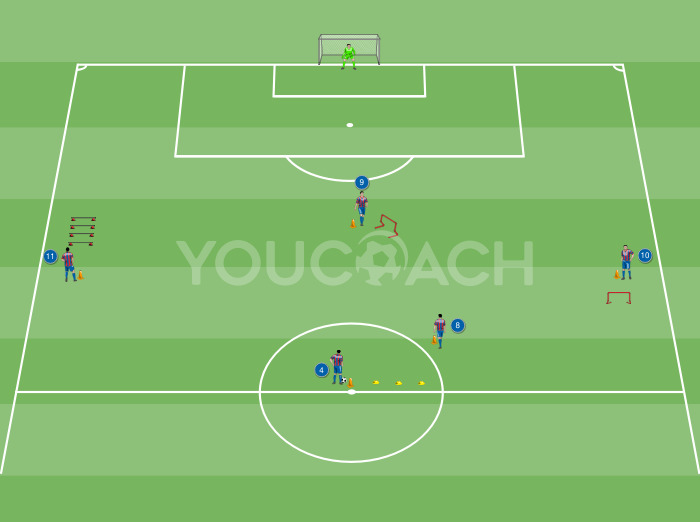
- 4 poles
- 2 mannequins
- 1 speed ladder
- 4 low hurdles
- Balls
- Playing area: 25x25 meters / 27x27 yd
- Players: 4
- Duration: 20 minutes
- Series: 4 of 4 minutes each with 1 minute of passive recovery in between series
Secondary Objectives
Creating space, Combination play, Receiving, Coordination, Pass, Mobility, TriangleOrganization
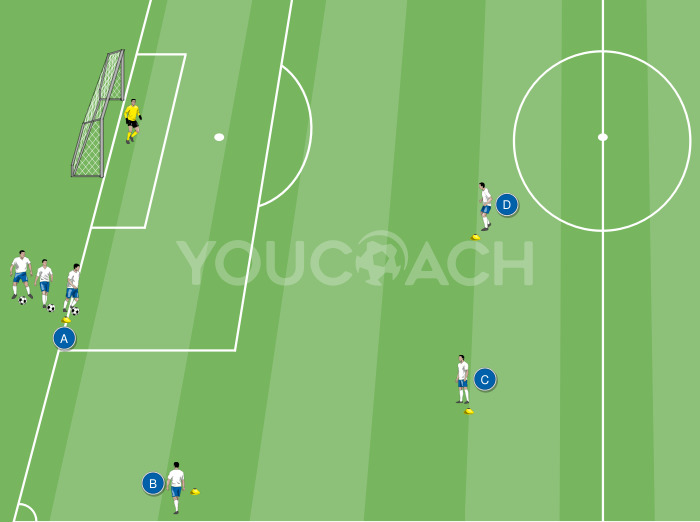
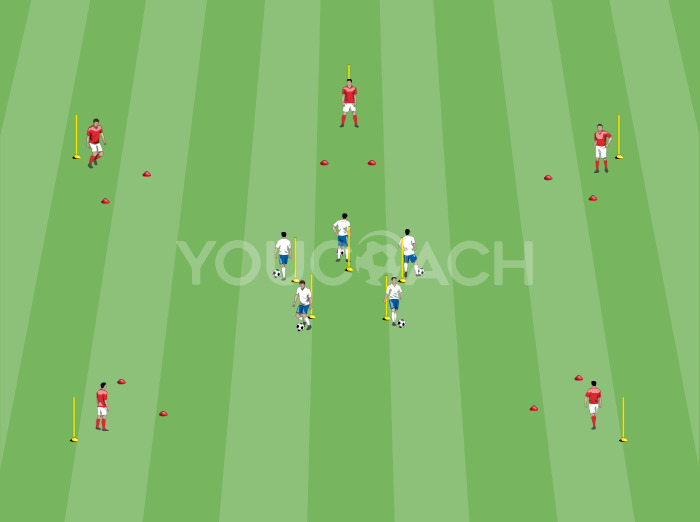
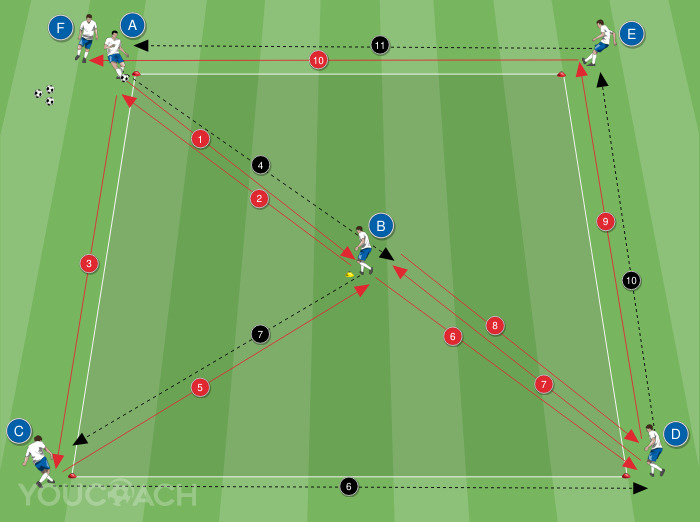
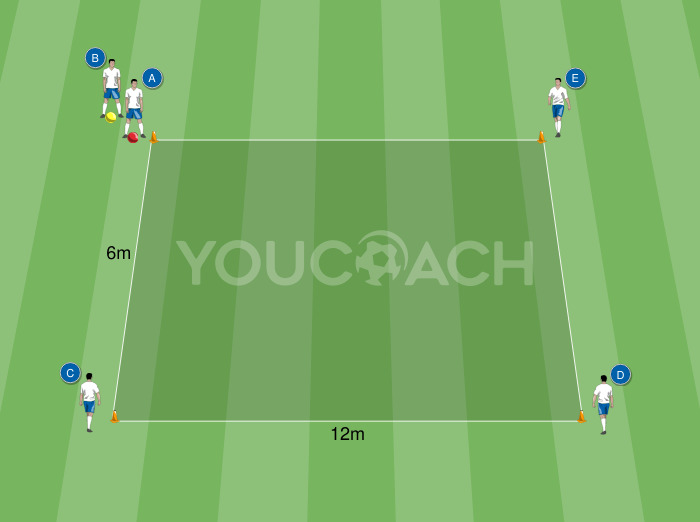
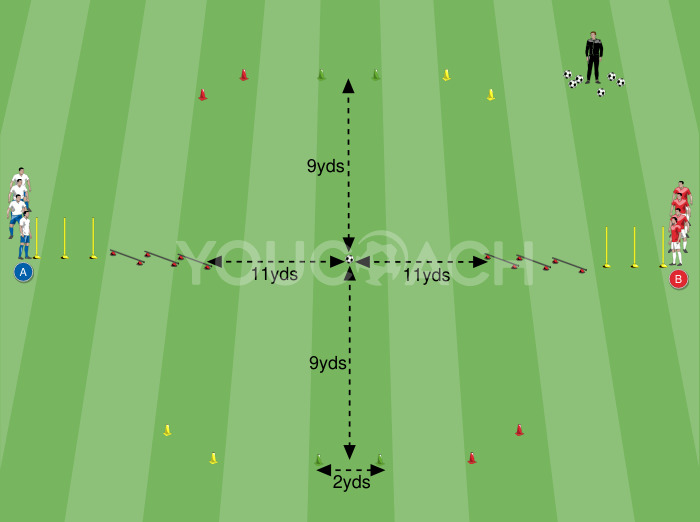
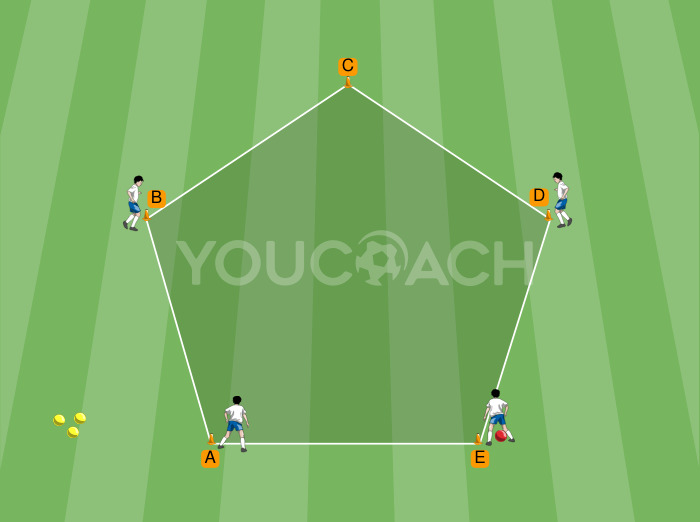
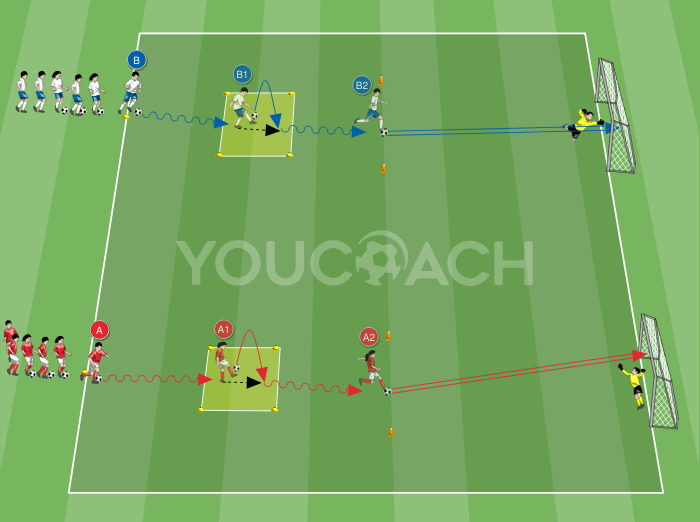
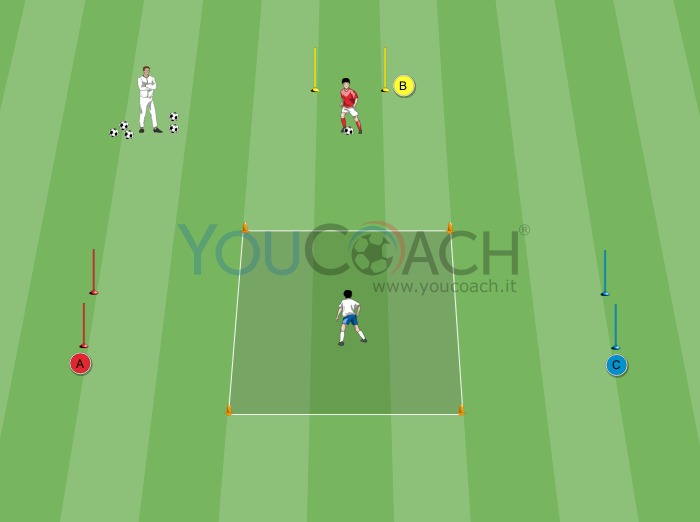
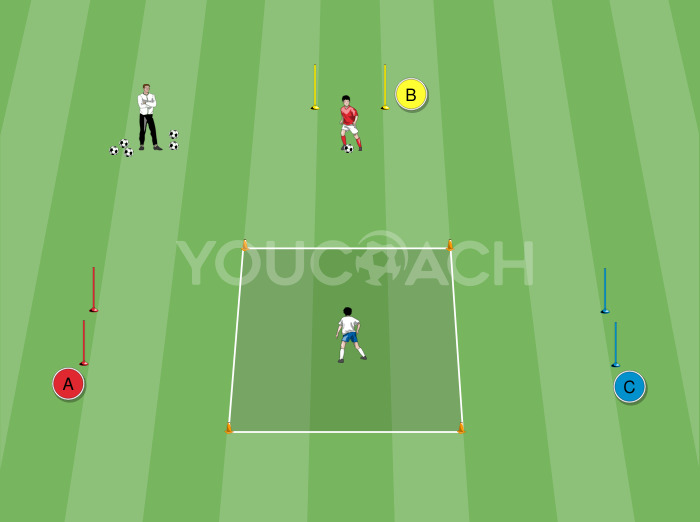
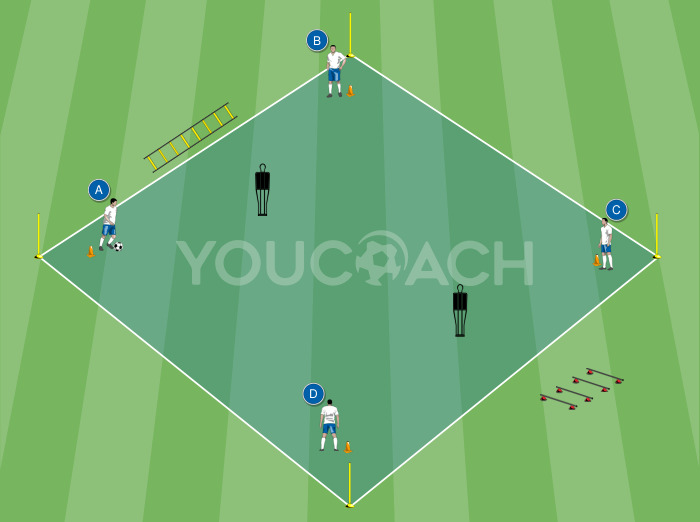
Place four poles at the vertices to create a diamond-shaped workstation. The length of the sides of the diamond will be about 25 meters. The four cones should be placed internally at a distance of about 2 meters from the yellow poles that mark the perimeter. Inside the diamond arrange two mannequins (as shown in the picture). Next to each cone place one player (A, B, C and D). Four other players will wait their turn each positioned behind a yellow pole. This will result in four pairs of players positioned at the four vertices of the workstation (at the four corners) for a total of eight players. The work is performed with one ball (starting with player A in the picture). Keep other balls near the corners to give continuity of work. Arrange a speed ladder and four low hurdles in the middle of two opposite sides as in the picture. The hurdles are arranged about 40 to 50 cm apart.
Description
- Exercise development:
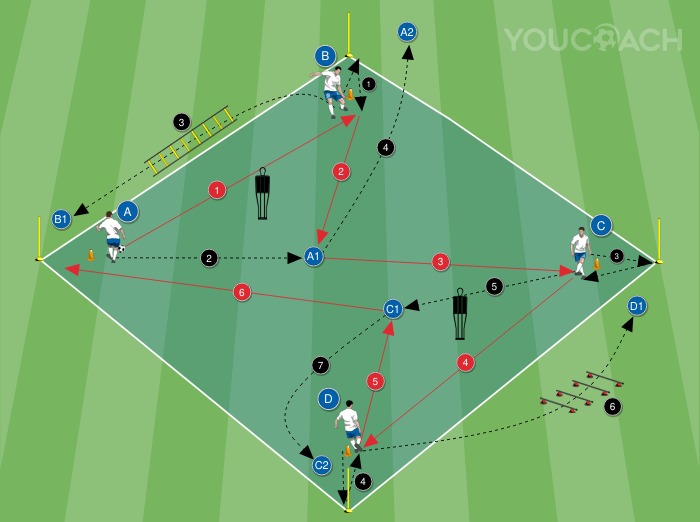
- Player B, after a countermovement between cone and pole, comes to receive A's pass inside the field
- Player B returns the ball on teammate A's movement into A1
- Player A transmits the ball to teammate C on the opposite corner, who countermoves in the meantime. Player B executes the speed ladder moving to B1
- Player A after passing the ball moves to position A2 (thus there is a reversal of the starting positions between players A and B). Player D, after a countermovement, comes to receive the pass from C
- Player D gives back the ball diagonally with wall play on the movement of C in C1
- Player C transmits the ball towards teammate B who has moved to the starting position, while D performs high knees on the four low hurdles moving to position D1
- Player C moves to C2
- Player B, after controlling the ball, starts the exercise again, and follows the same sequence of passes and movements with the roles reversed
- Reverse the starting direction after each series
Variations
- Limit the number of ball touches during ball transmission
- Vary the type of exercise on the speed ladder and on the hurdles
- Vary the type of control when receiving the ball (sole of the foot, inside of the foot, outside of the foot)
Coaching Points
- Pay attention to the quality of passes (strength and direction)
- Take care of the tempo in passing movements to receive the ball in the free zone (countermovement)
- Gradually decrease the running time between receiving and passing
- Maintain a high tempo (gradually increase the intensity of the drill)
- Take care of players' motor and coordination execution on the courses (speed ladder, hurdles)